



“Smart Money” and Transports
Every cycle has a handful of signals that don’t show up on CNBC tickers but matter a lot more than the day’s headline. For the last two decades, one of those tells has been hiding in plain sight inside the iShares Transportation Average ETF (IYT) — specifically, in massive dark pool prints that only the biggest players can put on.
Transports sit at the heart of the real economy. When goods stop moving, growth slows. When institutions capable of trading hundreds of millions in a single off‑exchange block quietly reposition in IYT near cycle peaks, they’re usually not reacting to today’s news flow; they’re pricing in the deterioration that hasn’t shown up in the data yet.
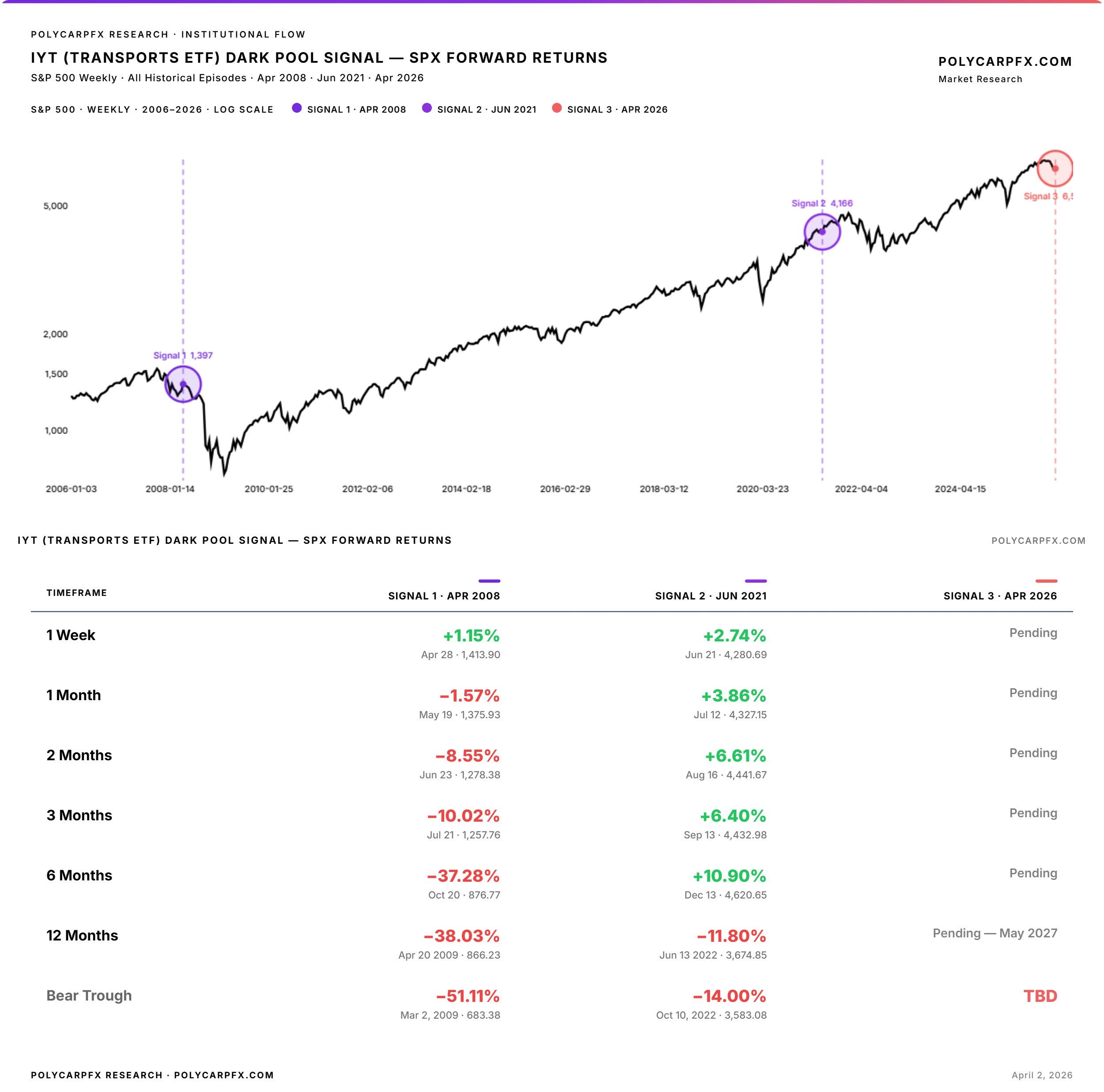
VolumeLeaders.com data flags two prior episodes where anomalously large IYT dark‑pool prints appeared near S&P 500 highs: April 21, 2008 and June 14, 2021. Both ultimately led to negative 12‑month SPX returns, despite very different macro backdrops. A third signal just fired in April 2026.
How the IYT Dark Pool Signal Is Defined
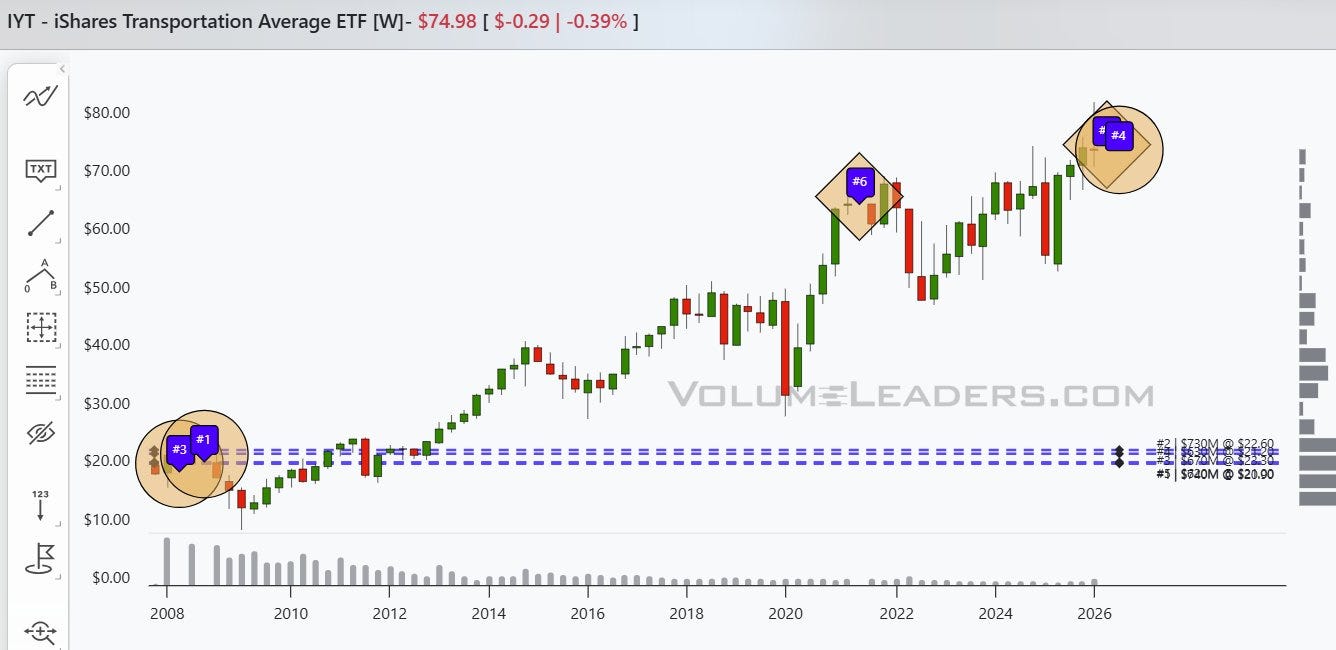
The prints in focus are not routine institutional flows. They are outsized, clustered, off‑exchange blocks that rank among the top VolumeLeaders positions in IYT — #1 and #3 in the 2008 cluster, #6 in 2021, and a new, similarly sized print in April 2026.
Key traits:
Anomalously high dark‑pool volume relative to normal IYT activity.
Occurring near prior or developing SPX highs, not in the middle of obvious panic.
Likely placed by entities with significant macro visibility and risk‑management mandates.
The hypothesis: when smart money chooses that moment to move aggressively in Transports, it is often marking the transition from late‑cycle complacency to a deterioration phase in broad equities.
What Happened After the First Two Signals
Episode I: April 2008 — False Stability Before a Crash
By April 21, 2008, the S&P 500 had already pulled back from its October 2007 high of 1,561 but was attempting a recovery. Price action looked “good enough” to lull investors into complacency. That is exactly when the big IYT dark‑pool prints hit.
Forward SPX performance from that signal:
1 week: +1.15%
1 month: −1.57%
2 months: −8.55%
3 months: −10.02%
6 months: −37.28%
12 months: −38.03%
The Lehman collapse in September 2008 turned steady deterioration into a historic crash. From the April signal close to the March 2, 2009 trough, SPX fell −51.1%, and −56.2% peak‑to‑trough from the 2007 high. The IYT signal gave roughly 47 weeks of advance notice before the generational low.
Episode II: June 2021 — A Longer Fuse, Same Direction
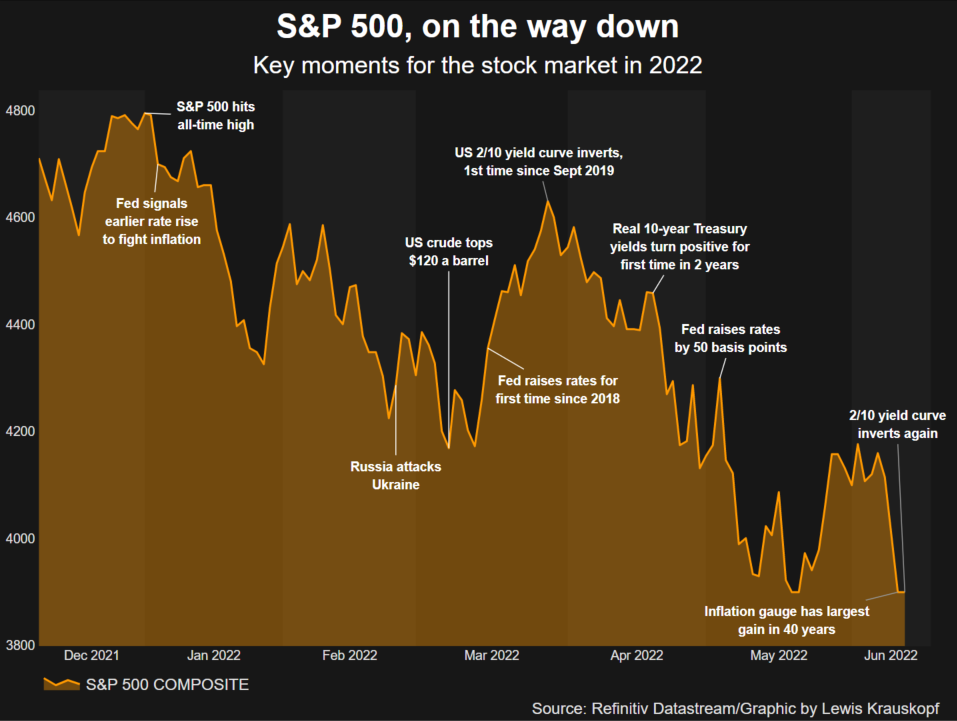
The June 14, 2021 signal behaved very differently in the short term. Rather than rolling over immediately, the S&P 500 pushed higher for six more months, peaking in late December 2021 at 4,766 — about +14.4% above the signal level. On the surface, it looked like another buy‑the‑dip cycle.
But the 12‑month math rhymed with 2008:
1 week: +2.74%
1 month: +3.86%
2 months: +6.61%
3 months: +6.40%
6 months: +10.90%
12 months: −11.8% by June 13, 2022)
The bear ultimately bottomed on October 10, 2022 at −14.0% from the signal and roughly −24.9% from the December 2021 peak. Different catalyst (Fed rate shock instead of a banking crisis), same story on a 12‑month horizon: the IYT print appeared near the end of the good times.
Different Short-Term Path, Same 12‑Month Destination
If you re‑index both episodes to 100 at the signal date and look 52 weeks forward, you see the defining feature of this pattern:
2008: rapid deterioration, deep crash.
2021: small runway of index gains, then a grinding bear.
Yet both paths resolve below the signal price by 12 months. The shape of the path differs; the direction at one‑year does not.
Structurally, both signals share another important trait: they fired during periods of apparent stability or gentle recovery, not at obvious moments of stress. When large dark‑pool buyers in Transports step in during those windows, they are usually early to the turn — not chasing fear.
April 2026: The Third Signal Just Fired
The new IYT dark‑pool print — structurally similar in size and context to the prior two — has now appeared. On a 20‑year weekly chart of the S&P 500, you can place three markers:
April 2008
June 2021
April 2026
The first two bookmarks align with the onset of major bear markets. The third sits at the far right edge of the chart with the index near all‑time highs.
Forward return outcomes for this new signal are, of course, pending:
1W, 1M, 2M, 3M, 6M, and 12M horizons are all to be determined.
The 2021 episode shows a six‑month window of further upside is possible after the print.
The 2008 episode reminds that deterioration can also begin almost immediately.
What the pattern has not done historically is resolve into a benign, positive 12‑month return. Both prior instances produced negative one‑year SPX performance, with drawdowns ranging from moderately painful to catastrophic.
How to Use (and Not Use) This Signal
There are important caveats:
