


ALHC closed at $7.99. That is a 52-week low, 67% below the July high of $24.56, and 38% below where it traded six sessions ago. Daily RSI(14) is 14. This is one of those opportunities where a long term holder can be discouraged and capitulate just as the ship is about to turn around. I wanted to do a quick write up to share the setup I am seeing for a company that has incredible opportunity long term (if it can execute) but short term has experienced a full on crash. I hope you enjoy the read, and if you do, consider sharing with your network. Cheers

What actually broke
Two legs, and they are not the same story.
Leg one, July 31, minus 20%. The quarter was clean. Revenue $1.34B, up 32%. Members 294K, up 31%. MBR 86.3%, 40 bps better than last year. Adjusted EBITDA $68M on a 5.1% margin, up 48%. They beat the high end of every metric they guide to. The stock got hit anyway because of what was said about the second half: only ~30% of full-year EBITDA lands in H2 versus ~40% a year ago, Q3 EBITDA guided to a thin $20–30M on a “seasonally higher MBR,” “double-digit millions” of incremental H2 investment, a warning that one to three competitors will bid more aggressively for 2027, and, quietly, they stopped disclosing the quarterly star-ratings metric. Full-year guide held at $5.20–5.23B revenue and $145–163M EBITDA. The market read the phasing as a soft pre-announcement.
Leg two, September 15–18, minus 35% on roughly 100M shares. At the Baird conference management put numbers on the pressure: institutional acute-care costs running hot on aggressive hospital billing, disputes and appeals including lagging 2025 bills; skilled-nursing length of stay creeping up; about $6M of unfavorable prior-year development tied to a claims-system transition; and $10–11M of unplanned spend in H2. They called it “operational and temporary.” They did not cut guidance. After July’s phasing warning, nobody gave them credit for either.
On top of that: a former chief transformation officer alleges $8–10M of routine opex was booked as capex in 2024–25, inflating adjusted EBITDA, and a class-action shop is now soliciting plaintiffs. On a ~$150M EBITDA base that is a rounding error operationally. It is not a rounding error for the multiple.
The Setup
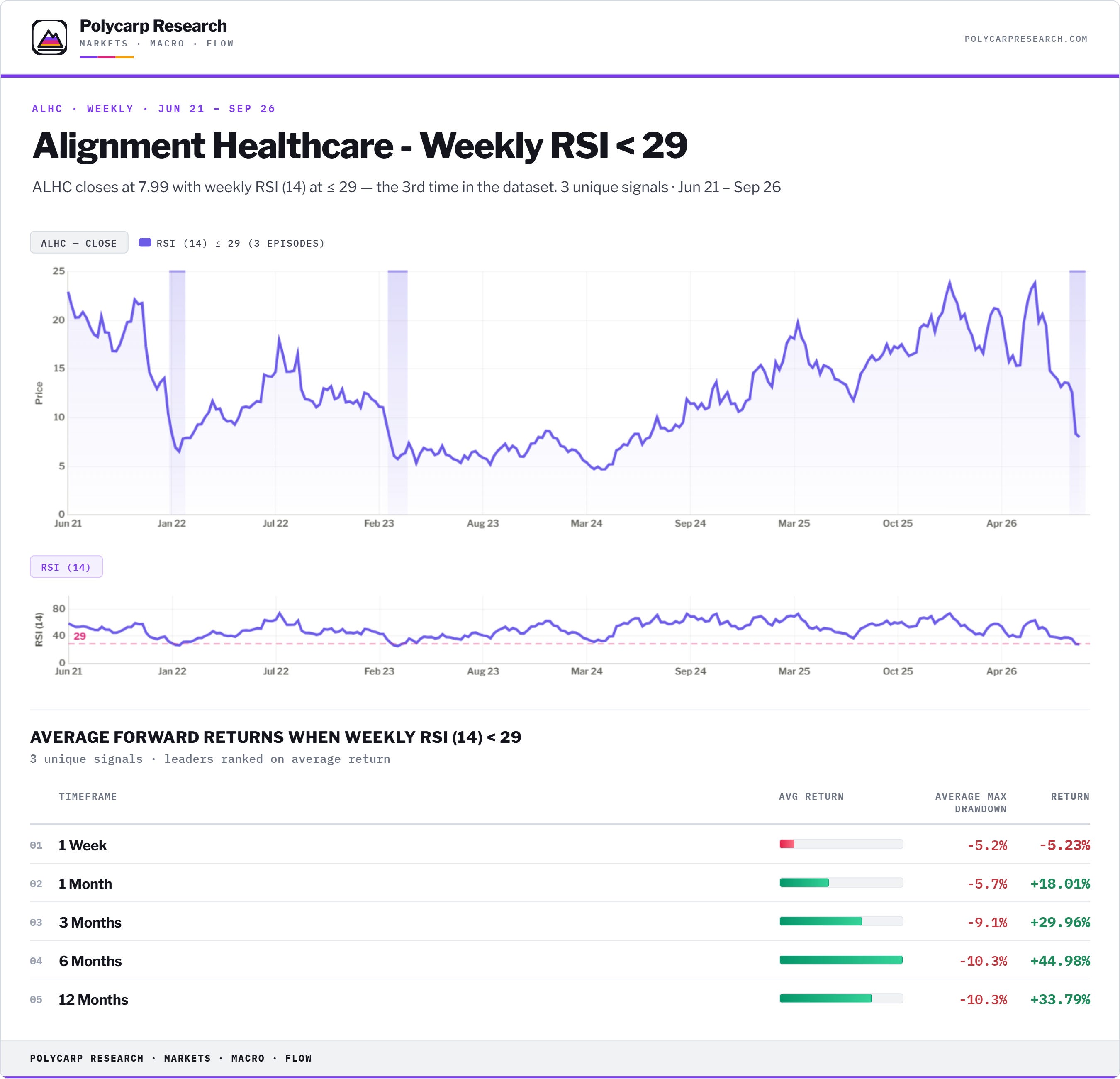
This is a fundamental re-rating that has overshot into a technical extreme. Both things are true and you trade them differently.
RSI at 14 on a stock that just did 100M shares in four days is washed out. Volume has already faded from 28M to 12M. The mean-reversion odds from here are good and the first two levels are obvious: $9.20 (where several desks have put near-term fair value and where the selling paused on the 17th), then $10.40, the bottom of the September 15 gap. The 50-day is $14.86 and falling; that is not a target, it is a ceiling for any relief rally until the cost story is resolved.
What the tape is not telling you is whether the cost problem is temporary. That gets answered by two events, not by RSI.
Why I am long anyway
Strip out the noise and you are paying about $1B of enterprise value ($1.66B cap less $693M cash) for a Medicare Advantage plan growing members 30%+ at $5B of revenue. Roughly 0.2× sales. The cohort economics management has shown for years still stand: MLR improves from ~93% in year one to ~82% by year five, and they peg embedded earnings power at $880M against a $640M guidance midpoint. If the H2 problem is hospital billing disputes and a claims migration, which is what they say it is, this is the cheapest quality MA grower in the market.
The moat is stars. 100% of members in 4-star-plus plans two years running, which is the 2027 bonus-revenue funnel. And the 2027 bids were filed “conservatively,” which reads as margin-first. Slower growth with an expanding MBR is exactly what a market that just punished growth-at-a-cost wants to see next.
What has to be true
Star ratings, mid-October. Plan Preview 2 first, then the official 2027 stars. Hold 4+ on the flagship plan and the first real de-risking event is behind us. Slip below 4 and the 2027 revenue base is impaired. That is the binary.
Q3 print, early November. MBR has to land inside the implied range. A second prior-period development charge kills “temporary.”
The whistleblower. If it becomes an audit-committee review or a restatement, the multiple stays compressed no matter how ops look.
Sector. UNH, HUM and CVS are under the same utilization pressure. ALHC is the high-beta expression of it; a peer guide-down drags this with it.
Playbook
Two tranches. Do not merge them.
Tranche one, now: the bounce. Trading size. Targets $9.20 then $10.40. Stop on a daily close under $7.85, today’s low. If it rips into the 50-day, sell it; you will get another look.
Tranche two, after stars: the investment. You give up a couple of points if October is clean. You avoid owning the full position through the one event that can actually break the thesis. That trade is worth making.
Defined risk for the window. Nov/Dec $8–10 or $8–12 call spreads carry the stars-plus-Q3 window for a fraction of the equity. IV is elevated, so the upper strike is paying for a good chunk of the lower one. No long premium into the Q3 print itself.
What makes me wrong: a star-ratings slip, a second PPD charge in Q3, or management cutting guidance in October after choosing not to cut it in September. That last one is the tell I am watching hardest. Flagging cost pressure while holding the guide is either confidence or a mistake, and we find out in seven weeks.
Evidence-led financial research combining macro, technicals, and flow to create an edge in every market environment
Join our premium subscribers with this special offer
Nice article and thanks! Any chance of fraud out there?