
Is AI the End of ServiceNow — or Its Next Leg Higher?
Company Deep Dive - Is this where long-term wealth is made — or lost.

There are very few companies in the software world that have earned the right to be called compounding machines. ServiceNow is one of them. From a niche IT service management platform to the de facto operating system for enterprise workflows, $NOW has executed its expansion playbook with remarkable consistency — growing gross profit at a 28% CAGR and free cash flow at a 32% CAGR over the past eight years.
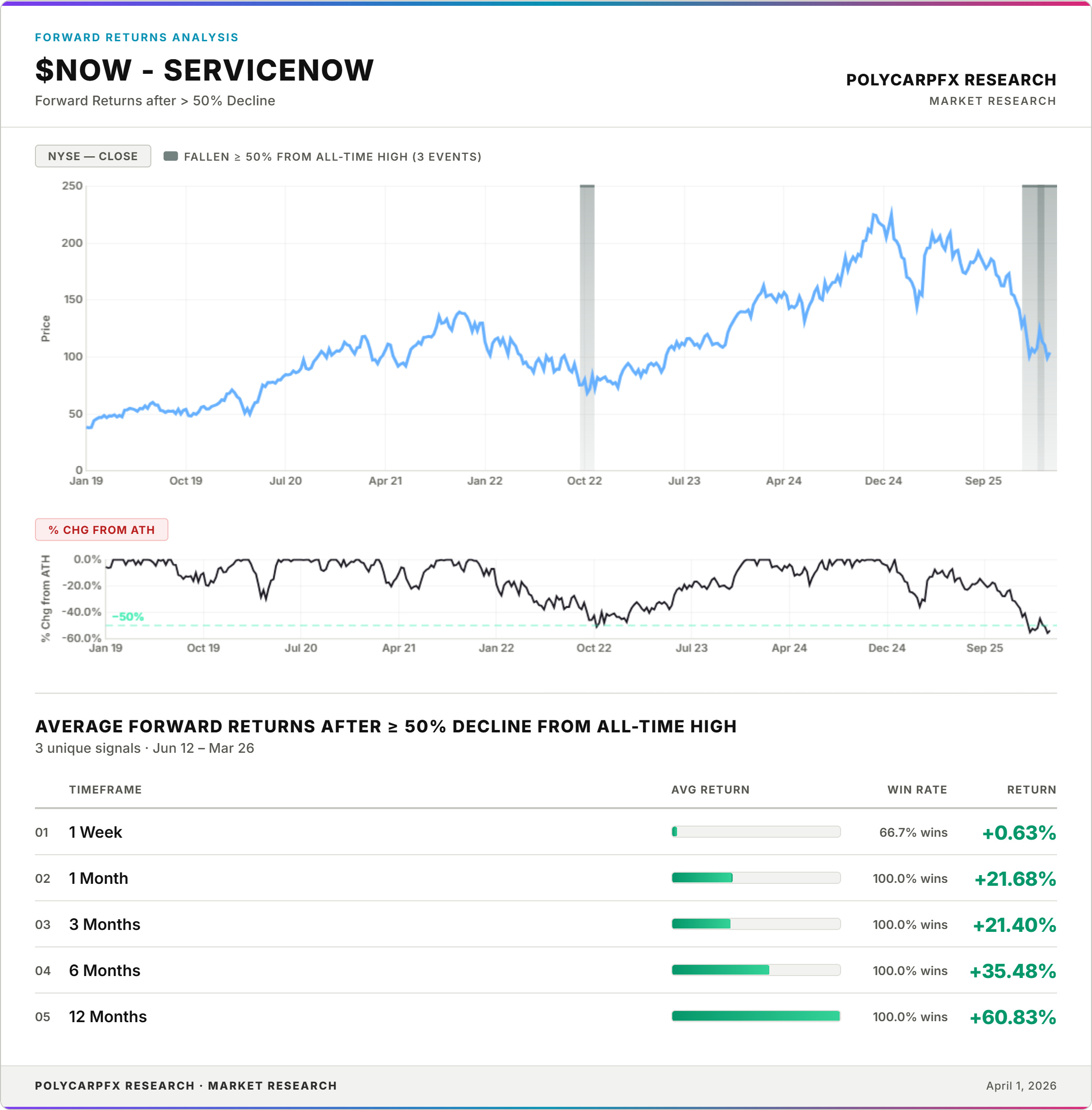
And yet, as of April 2026, $NOW sits more than 50% below its all-time high. The stock is showing a weekly RSI below 30 for the first time in years. The kind of setup that historically has preceded significant multi-month recoveries.
This report presents the data-driven bullish case for $NOW — combining quantitative forward return analysis across two distinct signal types with the fundamental picture underpinning a company that has never stopped compounding.
$NOW is simultaneously triggering two historically rare signals: a weekly RSI below 30 (4 episodes since IPO) and a drawdown exceeding 50% from all-time highs (3 prior episodes). Both signals, analyzed independently, show strongly positive forward returns across every medium-to-long timeframe.
Signal One: Weekly RSI ≤ 30
Weekly RSI sub-30 readings on $NOW are genuinely uncommon. Since the company went public in 2012, it has triggered this level exactly 4 times — including the current episode. That rarity matters: it means the signal isn’t noise. It’s exhaustion.
The chart below shows all RSI ≤ 30 episodes highlighted on the full price history, with the corresponding forward return table beneath it. The results are striking.
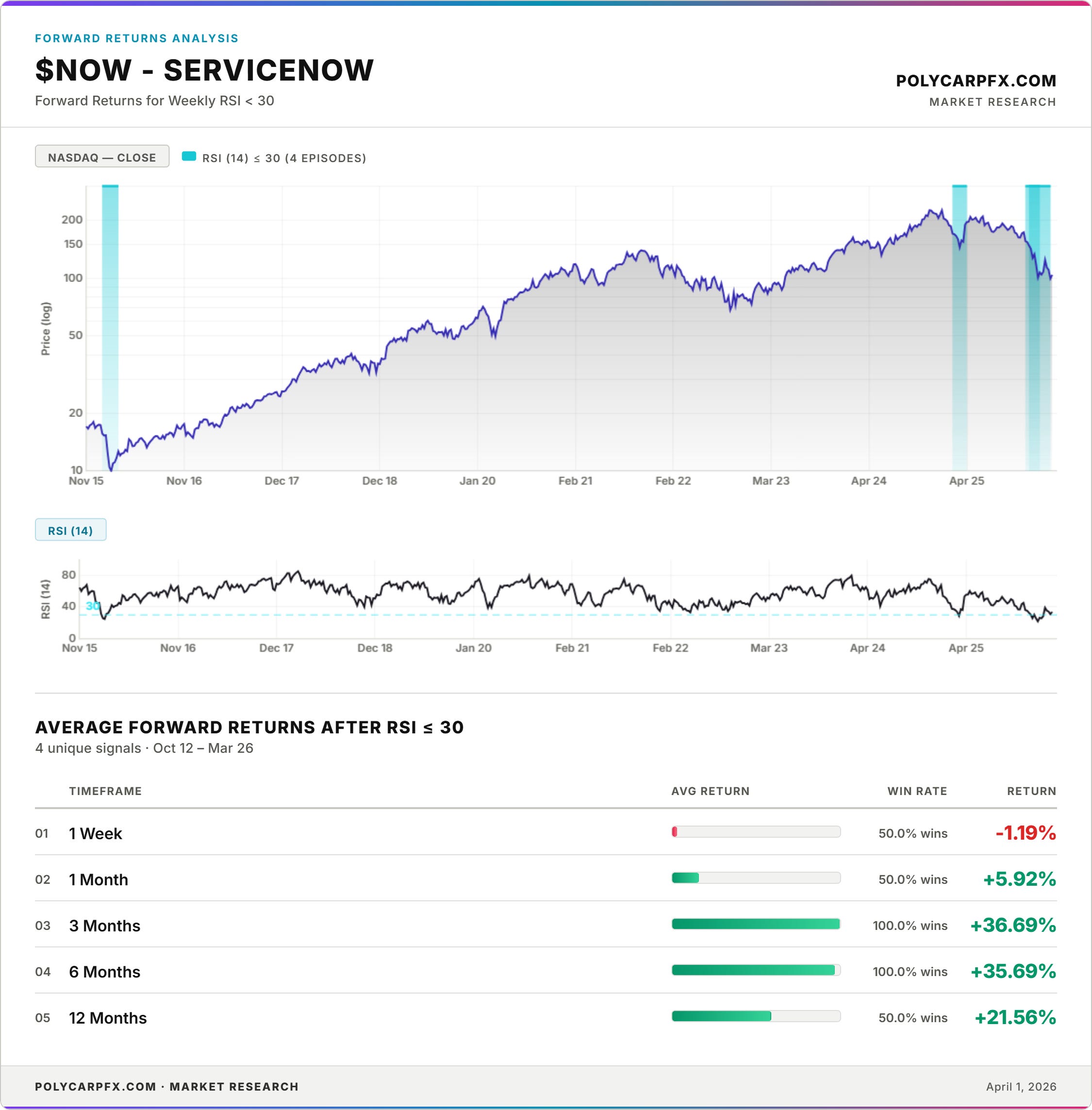
The 1-week return is modestly negative at –1.19% with a 50% win rate — no edge in the very near term, which is consistent with capitulation selling that doesn't stop on a dime. But the data improves dramatically as the timeframe extends:
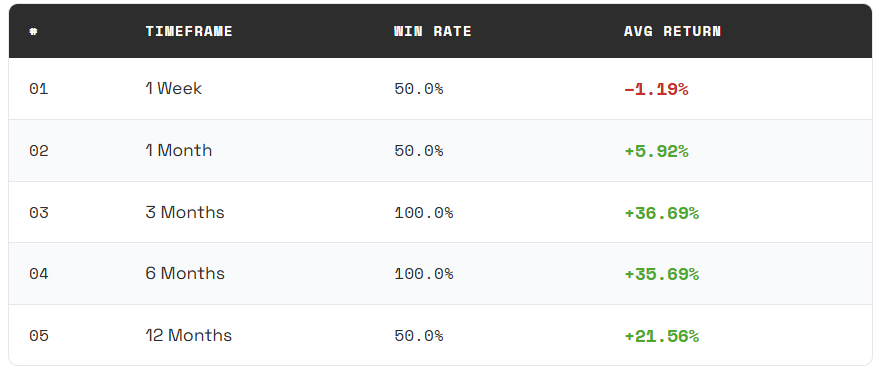
The 3-month and 6-month windows are the standout figures: 100% win rate with average returns of +36.69% and +35.69% respectively. Every prior instance of $NOW triggering weekly RSI ≤ 30 was higher 3 and 6 months later. That's the kind of historical consistency that deserves serious weight — especially when layered on top of a second confirming signal.
Signal Two: ≥ 50% Decline from All-Time High
Independent of RSI, $NOW is also currently trading more than 50% below its all-time high — only one other instance since the company went public. Drawdowns of this magnitude in a quality compounder are extraordinary events. They occur during periods of maximum fear, broken narratives, and indiscriminate liquidation.
History shows they are also extraordinary buying opportunities.
The Fundamental Engine Hasn’t Broken
Technical signals only matter if the underlying company still has the capacity to recover. With $NOW, the fundamental picture remains intact — and in many respects, it’s stronger than it’s ever been.
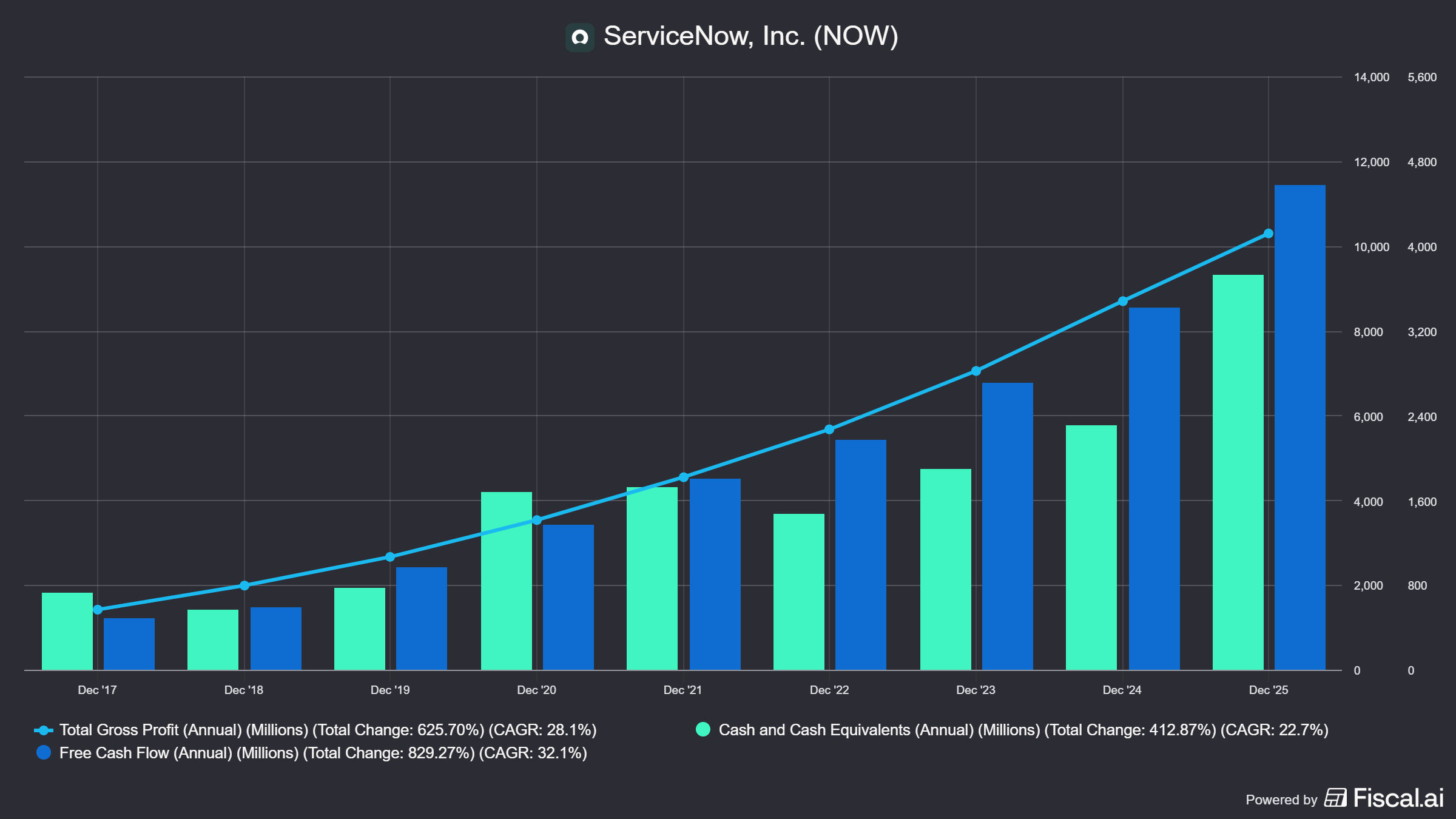
The financial trajectory here is as clean as it gets in enterprise software. Three key metrics, all compounding in the right direction over an eight-year span:
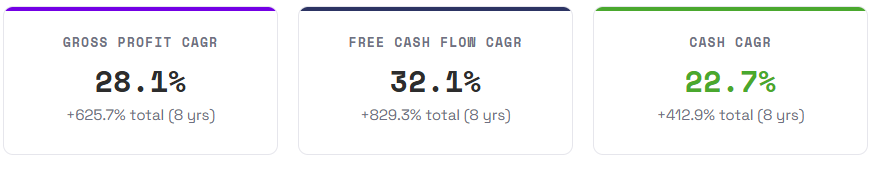
Free cash flow growing faster than gross profit tells you the operating leverage is real — as the business scales, margins expand. This is the hallmark of a software platform with durable pricing power and high net revenue retention. ServiceNow doesn't grow by discounting. It grows because enterprises can't afford to rip it out.
What ServiceNow Actually Does — and Why It’s Hard to Replace
ServiceNow started as an IT service management platform (think: the system your IT department uses when you submit a help desk ticket). Over the past decade, it has expanded far beyond IT into HR service delivery, customer service operations, legal, procurement, and now agentic AI workflows — all built on a single unified platform called the Now Platform.
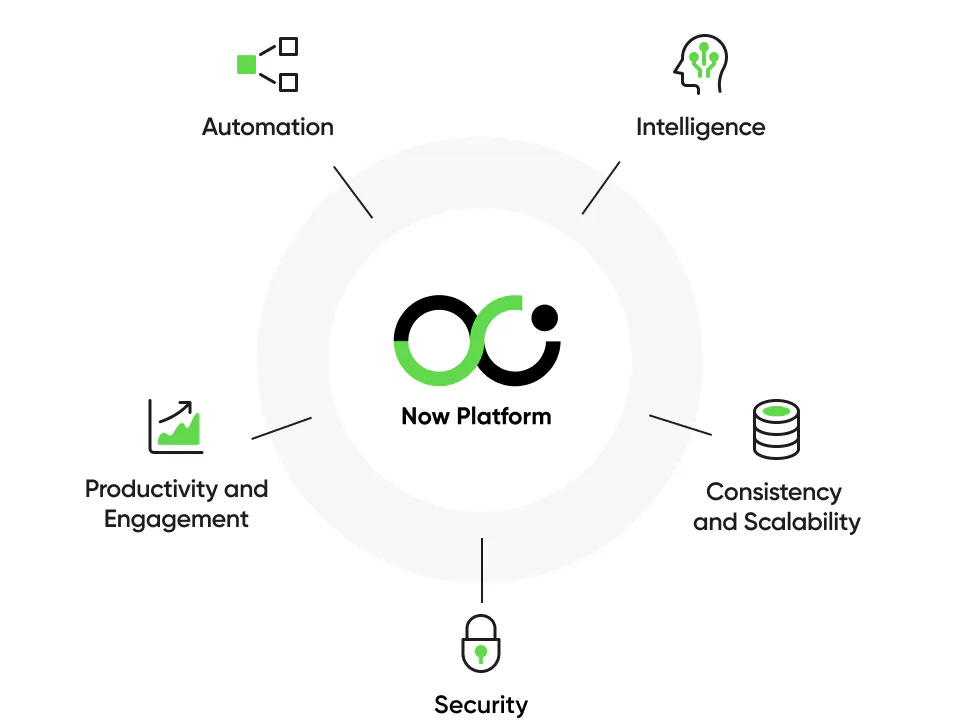
The strategic advantage ServiceNow has built is not any single product — it’s the platform gravity. Once an enterprise runs IT, HR, and customer operations on the Now Platform, the cost and complexity of switching is prohibitive. This creates the durable retention and expansion motion that underlies the FCF compounding machine visible in the financials.
The generative AI tailwind is real and meaningful here. Unlike companies building standalone AI products, ServiceNow is embedding AI natively into existing mission-critical workflows. Customers don’t need to buy a new tool — they upgrade within the platform they already depend on. That’s a fundamentally superior GTM motion in a budget-constrained enterprise environment.
What’s Driven the Drawdown — and Why It Doesn’t Change the Thesis
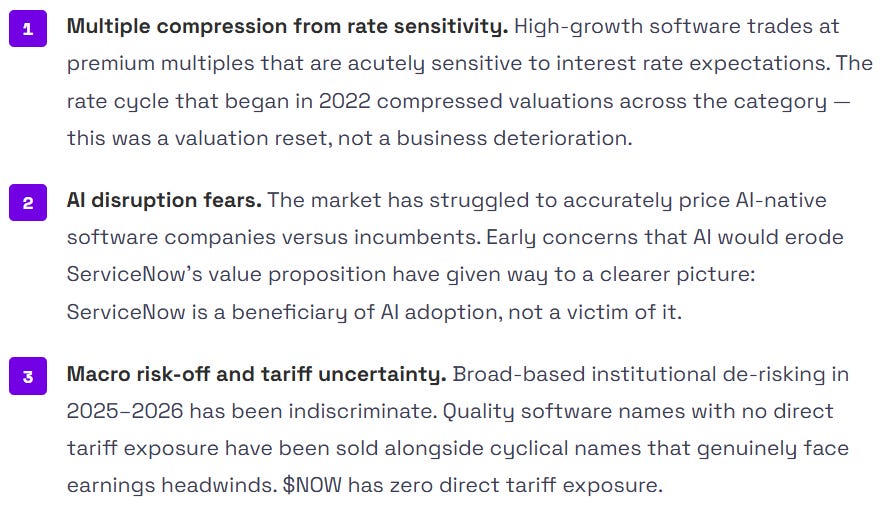
Understanding the drawdown context is important. $NOW has declined from its peak for a combination of macro and stock-specific reasons — none of which appear structural:
The Confluence of Signals — Why Now Matters
What makes the current setup unusual is the simultaneous triggering of two historically independent signals. The RSI sub-30 reading and the ≥50% ATH drawdown are both rare events — and they have not always occurred at the same time. Their current overlap creates a higher-conviction setup than either signal in isolation.
Across both signals combined, the 3-month and 6-month forward return data is remarkably consistent:
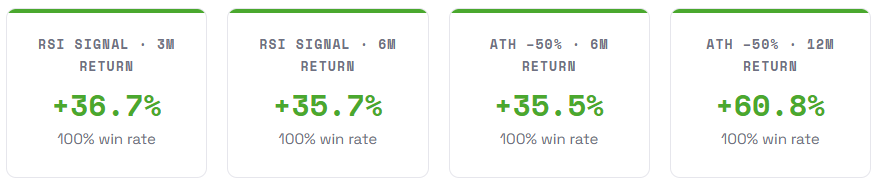
Three to twelve months out, the historical base rates are unambiguous. This doesn't guarantee any outcome — no forward return analysis does. But it should inform how you size and structure exposure when a company of this quality reaches a historically rare technical extreme.
How to Think About Sizing and Structure
Given the data above, the question becomes: how do you actually express this thesis? A few frameworks worth considering:
Staged equity accumulation. The 1-week data is coin-flip — which means timing precision is unlikely to help in the immediate term. Averaging into a position across 2–3 tranches over 4–6 weeks captures the signal without betting on a single entry.
Options for premium collection. Elevated implied volatility at these price levels creates attractive premium. Cash-secured puts at strikes you’d be comfortable owning shares allows you to either collect yield or acquire shares at an additional discount — both favorable outcomes.
The Bottom Line
ServiceNow is not a broken company. It is a category-defining enterprise software platform with nearly a decade of consistent financial compounding, an expanding AI product surface area, and deep institutional entrenchment across its customer base. The current drawdown reflects a toxic cocktail of macro fear, multiple compression, and sentiment — not fundamental deterioration.
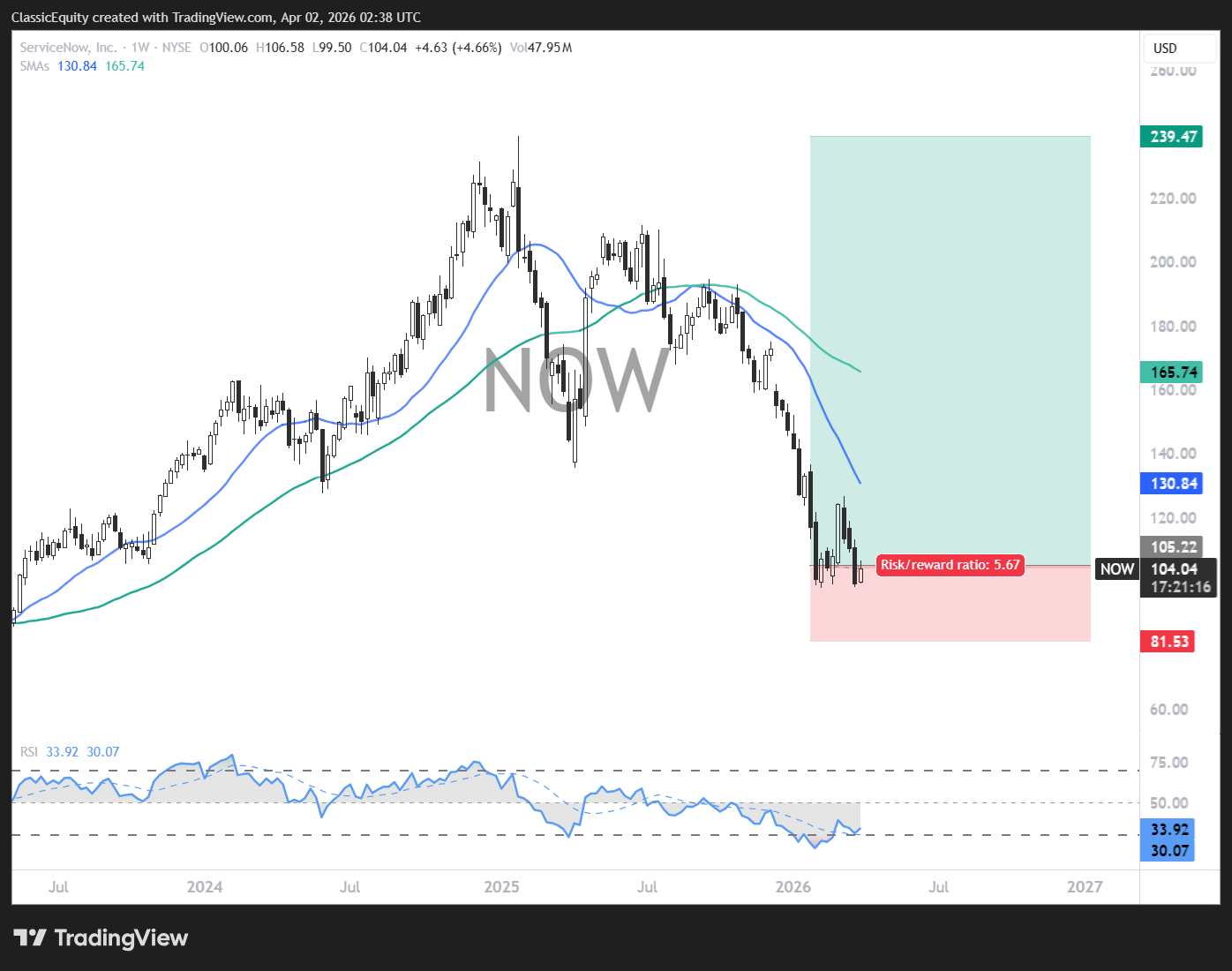
The quantitative signal is clear: in every prior instance that $NOW has traded at weekly RSI ≤ 30 and/or declined ≥ 50% from its all-time high, the stock has recovered materially over 3–12 month horizons. Both signals are active simultaneously today.
Quality on sale, confirmed by two independent historical signals, backed by one of the strongest FCF compounding records in enterprise software. That’s the $NOW setup heading into April 2026.
I share these type of reports weekly for free subscribers and I’ll be publishing my “Top Trade Idea’s of Q2” soon for paid subscribers, be sure to take advantage of my end of quarter deal. If you enjoyed the content, a follow, share, subscribe, restack, is huge support so thank you. Hope you all enjoy a strong Q2. Cheers!
Access to All of This: Paid Subscriber Benefits
If you want access to:
Q2 2026 Trade Idea’s (with full company reports and setups)
Top 10 Longs of 2026
Trading Indicator Primers
Seasonality Breakdowns (by sector and quarter for 2026)
Deep Dive Company Reports (ongoing throughout 2026)
Live Trade Updates and Exact Levels (for all major catalysts)
Private Discord Group (ask questions, share ideas, get real-time market color)